What actually moves the price
For a still, cost is attached to the size you pick. Some models charge the same for every size; others step, which is why a stepped model quotes a starting figure rather than a single one. For a clip, resolution sets a rate per second and length multiplies it, so a long clip at a high resolution is not slightly dearer than a short draft at the bottom of the ladder. It is the higher rate paid across every second you asked for.
Aspect ratio costs nothing: it changes the shape of the frame, not the bill. Reference pictures can, because some editing models charge for each one after the first, and the panel folds that into the figure on the generate button.
Do not budget from prose, this page included. Every model page lists that model's own sizes or resolutions with the credit cost beside each, read live from the table the server bills from, and the pricing page puts the catalog in one view.
One model's ladder does not carry across to another: steps, ratios and length ranges are all per model.
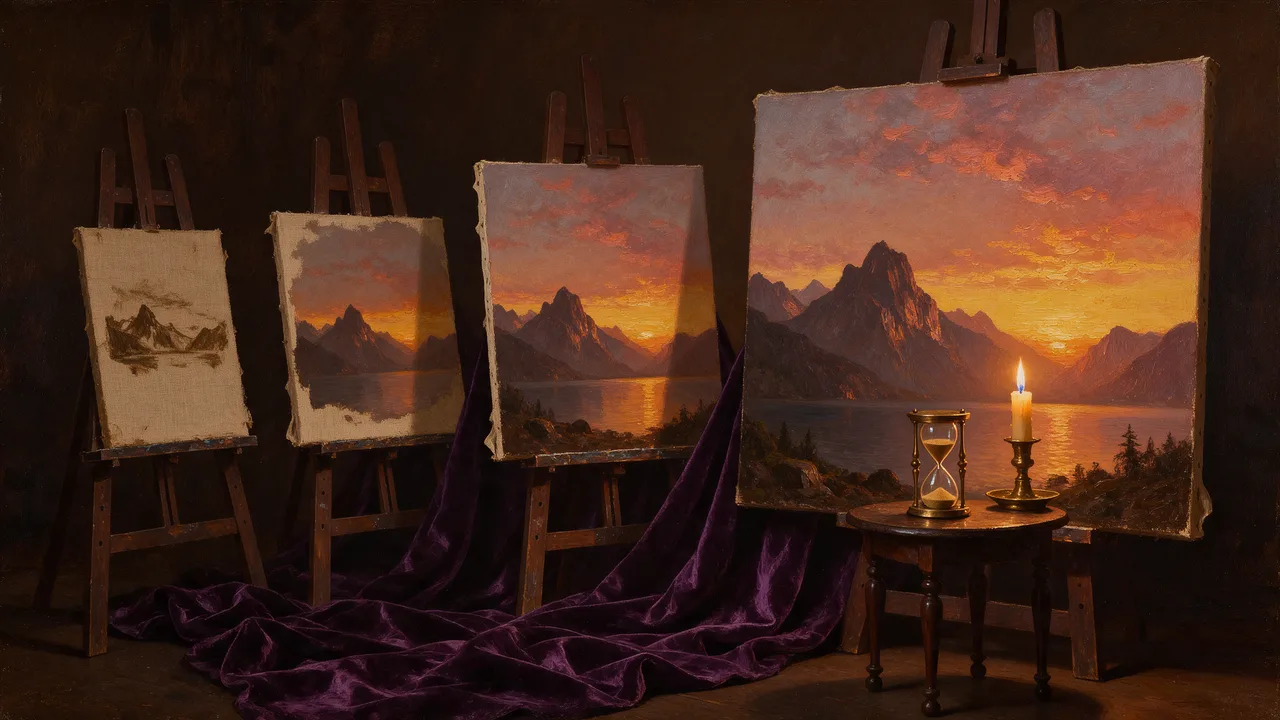
Settle the shot at the bottom of the ladder
Everything still in question belongs at the cheap step: whether the subject is the one you meant, whether the composition holds, whether your wording landed, and for video whether the action fits the length you asked for.
What the cheap step is not is a preview of the expensive one. In the SDXL paper, Podell and colleagues condition the model on the original size of its training images and report that "the image quality clearly increases when conditioning on larger image sizes", which is a documented property of that conditioning scheme rather than a claim about any model here. Read a low draft for staging, framing and whether the prompt did what you wrote it to do. Do not read it for skin, hands, distant faces or small text, because those are exactly where a low draft misleads you. For video, length is the second handle, and a short draft answers "is this the shot" for a fraction of a full run; going from a still to a video covers the rest of that pass.
A re-run is a new roll, not a re-render
Even where a seed is available the same number does not guarantee the same frame, and models that declare none give you nothing to pin, so re-running the same prompt at a higher step does not enlarge what you saw, it starts over. The Hugging Face Diffusers documentation on reproducibility opens on the general case: "Diffusion is a random process that generates a different output every time." Even where a seed is available, the same page warns that you "can try to limit randomness, but it is not guaranteed even with an identical seed".
So read the draft expecting the expensive run to come back different rather than merely bigger, and ask what has to survive the trip. Wording survives, because you send it again. Composition mostly does. A particular face, jacket or room does not survive on wording alone, and if that is what you liked, the draft itself has to go forward as an input, which is what editing models are for. Keeping a character consistent is that subject end to end.
Stop editing the prompt before you go up. Raise the step and rewrite in the same run and a disappointing result cannot tell you which change did it. Settle the words first, with prompts written without a filter, and then move the setting.
Length and shape belong to the model
Duration is a range with a floor and a ceiling belonging to the model, and a request outside it is refused with the range named in the error rather than trimmed to fit. A clip quietly shortened to what the model accepts, and billed, looks exactly like the clip you asked for until you play it. Compare Wan 3.0, which reaches the longest takes in the catalog together with Wan 3.0 Pro and Seedance 2.5, with MiniMax H3 Max, whose ceiling is lower; each page lists its own range.
Ratio works the same way in both directions. A model that offers ratios takes them from a closed list, and a model that offers none turns down a request carrying one instead of dropping it, because a silently ignored ratio means paying for a shape you did not choose.
That constraint comes from training rather than from policy. The SDXL paper motivates its aspect-ratio buckets by observing that "real-world datasets include images of widely varying sizes and aspect-ratios", and a model is at its most predictable inside the shapes it was trained on. So pick a model from the catalog that already makes the shape you need, rather than planning to crop your way into it afterwards.
When a request is refused, and when it is billed
A rejected request costs nothing, because validation runs before credits are taken. An unknown size, an out-of-range duration, a ratio on a model that offers none, a missing or unwanted reference: each comes back as an error naming the parameter, with your balance untouched. Credits come off when a run starts, and if the run then fails the refund is automatic; calling the API from your code has the status codes and the settlement rules.
Download the run you decided to keep. Driving this from a script, take sizes, resolutions, ratios and length ranges from the catalog rather than from a constant in your source, so a change on our side arrives as a new value rather than as a rejection. For a whole grid of variations rather than one ladder, see concept art.